AI could upend livelihoods faster than communities can adapt. What could we build if people, AI, and robots learned to work together?

Imagine getting laid off on a Friday. On the drive home you pass a construction site that has sat idle for months, then a clinic where it takes weeks to get an appointment. You know there’s work to do. You also know none of it will pay your mortgage on Monday. That gap is what makes a “job-astrophe” possible.
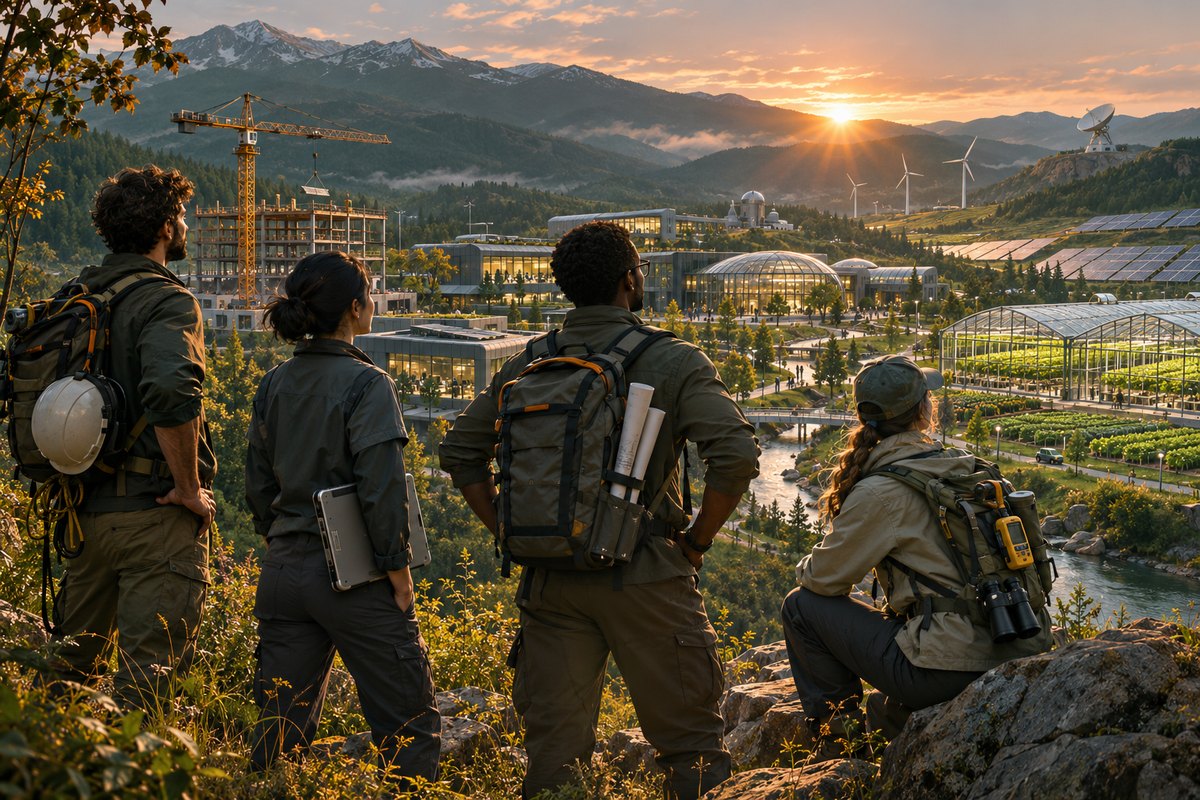
Editorial illustration of a possible future research and infrastructure campus.
Change the question we ask about AI
When we talk about AI and jobs, we tend to picture today’s economy with fewer people in it. That’s an understandable fear. Now picture a grower walking a field with a soil scientist. An AI model flags where rainwater might collect. A small rover samples those spots. The scientist checks the readings, the grower points out what happens after a hard rain, and together they revise the plan.
The International Labour Organization estimated in 2025 that roughly one in four workers worldwide was in an occupation with some exposure to generative AI. Exposure measures what the technology could affect. The study expects job transformation to be more common than outright replacement, while the speed and local concentration of disruption remain uncertain.
That kind of teamwork depends on a good handoff. People set the goal and limits. AI sorts through the data and suggests where to look. Robots measure or act in the physical world and report what happened. People need to see what each system did, catch a bad call, and stop the equipment when something changes. Designing, operating, and maintaining those handoffs is work in its own right. To turn that possibility into jobs, we have to teach the skills, make it possible for workers to learn them, and agree on what to build together.
Rebuild education around the work people will do
Every university department should revisit its syllabus. An engineering student should use AI to compare designs and defend a choice against physical tests. A nursing student should practice checking an AI-generated summary against a simulated patient record. An agriculture student should test a model’s advice on local field data and explain when a grower should disregard it.
Give students a chance to practice the whole handoff. A team could send a robot to survey a plot, use AI to flag odd readings, then return to the field to find out whether the trouble was in the soil or in a broken sensor. Ask students to explain what they trusted, what they checked themselves, and when they would stop the equipment. Keep the science and judgment that make those answers possible.
Universities, community colleges, trade schools, and employers can share teaching labs and offer paid placements. A midcareer worker should be able to build on existing experience through shorter courses and apprenticeships tied to actual vacancies. That matters most to someone who needs a paycheck while learning a new trade.
A university could team up with a utility and a trade school for a semester. Engineering students design an inspection route, apprentices learn to maintain the drones, and experienced lineworkers teach everyone where the model gets the terrain wrong. The utility gets a tested process and the students leave with experience they can show an employer.
Build a bridge before jobs disappear
Start with projects that already need people. A regional utility could partner with a technical college and worker representatives to train displaced employees for grid modernization. An office administrator might move into project coordination. A technician might earn a credential to service storage systems. Publish the available positions, wages, prerequisites, and placement results before asking people to commit.
During the transition, income support, paid training time, childcare, and transport can determine who can participate. A course on industrial robots should lead to paid time alongside the crew that installs and repairs them. Workers should have a voice in how automation changes their roles and how the gains are shared. Track who finds durable employment, how their earnings change, and which communities still lack a credible path forward. Local partnerships can make those paths real. Some of the most worthwhile projects, though, will need countries to work together.
Give leaders a reason to cooperate
Competition can motivate discovery. It can also encourage countries and firms to hoard tools or shift the costs of disruption onto people with the least bargaining power. Leaders can start with practical agreements on challenges that cross borders. Share asteroid observations and space-weather alerts, fund disease research with access commitments, and support training and computing capacity in countries that would otherwise be left out.
A useful agreement names who funds the work, who can access the results, and how progress is checked. Imagine several countries funding a shared network of genomic labs. Each trains local technicians and controls access to its sensitive data, while the network shares validated outbreak findings quickly. Give countries a real role in setting priorities and a way to bring the benefits home.
So what might all that training, investment, and cooperation make possible? Start with something almost every other project depends on: affordable energy.
What would we do with energy this abundant?
Imagine a coastal city with enough affordable clean power to run a desalination plant through a drought, or a factory that can replace fossil heat without pricing itself out of business. That’s the practical promise behind the dream of unlimited energy. Getting there means making electricity cheap to produce, delivering it where people need it, and keeping it available through the night and through bad weather.
Make a cheaper solar panel, then build a better solar farm
Start in the lab. An AI system could propose a coating that uses less expensive material. Robotic arms could make dozens of variants, test them under heat, humidity, and light, and feed the results back into the next round. Researchers have already paired machine learning with automated fabrication to make experimental perovskite solar cells more reproducibly. The bigger prize is a panel a factory can make cheaply by the million, with few defects and a long enough life to save money over decades.
Now picture a utility deciding where to put a gigawatt of solar. The sunniest plot might be miles from a usable grid connection. AI could help compare weather, terrain, existing power lines, habitat, and local land use. Engineers could then simulate panel tilt, row spacing, sun-tracking equipment, and battery size. A design that generates more at noon may be worth less than one that can still deliver power when people get home. Local communities and grid operators need to help decide what the project should optimize for.
Out in the field, survey drones could check terrain, machines could place mounting posts and panels, and thermal cameras could help crews find failing modules across thousands of rows. Electricians would connect and test the plant. Mechanics would keep the equipment running. Building clean power at that scale means training people to work with the machines as well as building the machines themselves.
Nature study on machine learning and robotic solar-cell fabrication
National Laboratory of the Rockies renewable energy siting model
Could fusion go from the lab to a city, or even into a vehicle?
In Switzerland, researchers have already used a trained AI controller to shape the plasma in an experimental fusion machine by adjusting its magnets. That gives engineers another way to control something extraordinarily hard to keep steady. A working power plant has a much longer list of jobs. It has to deliver more electricity than the whole facility uses, remove enormous amounts of heat, protect components from radiation, and, for common proposed designs, manage a supply of tritium fuel.
If teams can solve those problems affordably, imagine large plants supplying regional grids and smaller modules near cities or industrial sites supplying electricity and useful heat. A compact reactor still needs room for shielding, cooling, and maintenance, and each site would need to meet safety and licensing requirements. Remote-controlled robots could inspect hard-to-reach areas or replace heavy components after shutdown. Operators, radiation-protection specialists, and robotic maintenance crews would have to practice those repairs long before the first plant opened.
Could one ever power a plane or a car directly? That’s a far-future question. Even if the reactor core shrank, the aircraft would have to lift the shielding and cooling equipment and carry it safely through emergencies. A car would have to do all of that at a price people could afford and withstand a crash. A nearer route would be stationary fusion plants supplying electricity for cars or, if the economics work, clean power to make synthetic aviation fuels.
Experimental AI plasma control in a Swiss tokamak
ITER on turning fusion into usable energy
U.S. Department of Energy fusion roadmap, including remote maintenance
Could we make some diseases disappear?
AlphaFold showed that machine learning can predict many protein structures with accuracy comparable to experimental structures in a benchmark. That can help researchers decide which questions to take into the lab. A useful treatment still requires experiments, clinical evidence, manufacturing, and a way to reach patients.
Imagine a clinic spotting an unusual cluster of infections. With appropriate privacy protections, AI could help public-health teams compare those reports with wastewater readings and genetic sequences. Lab robots could prepare samples around the clock. Epidemiologists would check whether the signal was real, and local health teams would decide where testing or vaccination could interrupt transmission. For some diseases the ambition is eradication. For others, earlier detection and fewer deaths would already change millions of lives.
The same partnership could speed up drug discovery. A model could propose molecules, robots could test them against cells, and scientists could use the failures to design the next round. Trial coordinators, nurses, and manufacturing teams would still have to turn a promising experiment into a treatment people can get.

Use genetics to help more people live healthier lives
In 2025, researchers gave an infant with a rare, life-threatening metabolic disorder a gene-editing treatment designed around his specific mutation. It was a single case with encouraging early results. The FDA had already approved a CRISPR-based treatment for certain patients with sickle cell disease, showing another route from an inherited condition to a treatment.
Imagine what it would take to make that kind of care available to more families. AI could help researchers prioritize candidate edits and flag places where an edit might go wrong. Robots could prepare and screen samples. Genetic counselors would explain options to families, clinical teams would test safety and benefit, and manufacturing specialists would make reliable doses. Follow-up would tell us how long the benefits last.
A healthier humanity could mean fewer children in pain from inherited disease and more adults able to live independently. Editing a consenting patient’s cells to treat a condition raises different questions from changing DNA that future generations would inherit. Strength and resilience also depend on nutrition, environment, and access to care. Those are worth investing in alongside genetics.
Could we grow more food on land we’ve damaged?
Think of a dryland farm where wind has stripped away topsoil and rain runs off before it can soak in. Satellite images and an AI model could help a local team choose where to test ways of slowing that runoff. A rover could take repeat soil readings while crews try ground cover, water harvesting, or drought-tolerant crops on small plots. After a season, the people who farm there could decide what is worth keeping.
An intact desert is already a living ecosystem. On degraded drylands, restoring native vegetation or rangeland may be the right outcome. Where farming makes sense, the real test is whether soils recover and harvests improve without draining the water supply or pushing out the people who depend on it.
If the trials work, seeders could plant cover crops in precise strips and field robots could track soil moisture across farms. The growers would compare results with neighboring plots and decide what to scale. That creates work for people who know how to restore land, repair machinery in the field, and teach others what worked.
What would healthier food production look like?
If a community wants meat raised without added growth hormones, farmers could try different feed and husbandry practices. Automated sensors could track how the animals are doing, and AI could help sift through the readings. Independent labs could measure residues and nutrition, while veterinarians check animal welfare. Then the community could see what those choices cost and what they actually change.
The U.S. FDA considers meat from animals treated with approved growth implants safe when the implants are used as directed. Any claim that a different practice makes food healthier needs evidence. The same applies to plant proteins and foods made with fermentation. How nutritious are they? Who can safely eat them? Can families afford them, and do they want to?
What if we grew more of our food in the ocean?
Picture a coastal crew pulling up a line of kelp while a small underwater robot checks the moorings. We already farm seaweed and shellfish. In suitable locations, kelp and mussels can grow without added feed or freshwater. AI could help growers make sense of changes in currents, water quality, or weather, and underwater robots could inspect equipment between visits.
A marine farmer still decides what to grow and when to harvest. A food-safety team checks what comes ashore. And people who fish or live nearby deserve a say in where the farm goes. Before expanding, a farm should show how it affects wildlife, navigation, and water quality.
A successful farm could support a hatchery, a local processing plant, and crews that maintain ocean sensors and robots. A cold-water kelp farm and a warmer-water shellfish farm would each need people who understand their own coast.
Put the same teamwork on a building site
On an affordable housing project, AI could flag a pipe that runs through a beam in the drawings. A survey robot could measure what’s actually on site. The plumber, structural engineer, and inspector could then decide what to change before the walls go up.
Now picture a factory making wall panels for hundreds of homes. Robots cut and lift the heavy pieces, while carpenters check joints and fix the surprises that show up when the modules reach the site. The same tools could help retrofit older homes for heat waves. The outcome to measure is how many people get a safe home they can afford, including those who already live in the neighborhood.
Keep water flowing and reach people after disasters
A city facing water shortages could use AI to compare pressure readings and flag an underground leak. An inspection robot could check the pipe, and a utility crew could make the repair before a street floods. The measure that matters is how much water the city saves and how many households get reliable service.
After a flood or earthquake, drones could map damaged roads and ground robots could look inside unstable buildings. AI could help crews sort incoming images and identify areas worth checking first. A rescue commander would weigh those reports against calls from residents and decide where to send people. Keeping the equipment ready would take trained operators, mechanics, and emergency teams that have practiced together before disaster strikes.
Prepare for threats no country can handle alone
NASA’s DART mission demonstrated that a spacecraft impact could change an asteroid moonlet’s orbit. AI could help prioritize telescope observations and flag candidates for astronomers to confirm. The work includes maintaining instruments, checking trajectories, planning missions, and agreeing internationally on when to act.
Solar flares and related eruptions pose a different problem. We can build earlier warnings and more resilient grids, satellites, and communications. AI could help analysts sift through observations, while forecasters, grid operators, and emergency managers decide how to respond.
Imagine observatories in different countries handing off an asteroid observation as night moves around the planet. AI could flag an uncertain orbit, robotic telescopes could follow up, and astronomers could agree on what the new measurements mean. If a threat were confirmed, spacecraft engineers, mission operators, and public officials would have to act together. The same habit of sharing observations and rehearsing decisions would help during severe space weather.
The work ahead
Go back to that drive home. The clinic still needs staff. The unfinished homes still need crews. With the right investment, the person who lost a job on Friday might have a paid path into work the town has needed for years. That’s a future worth working toward. What would your community build first?