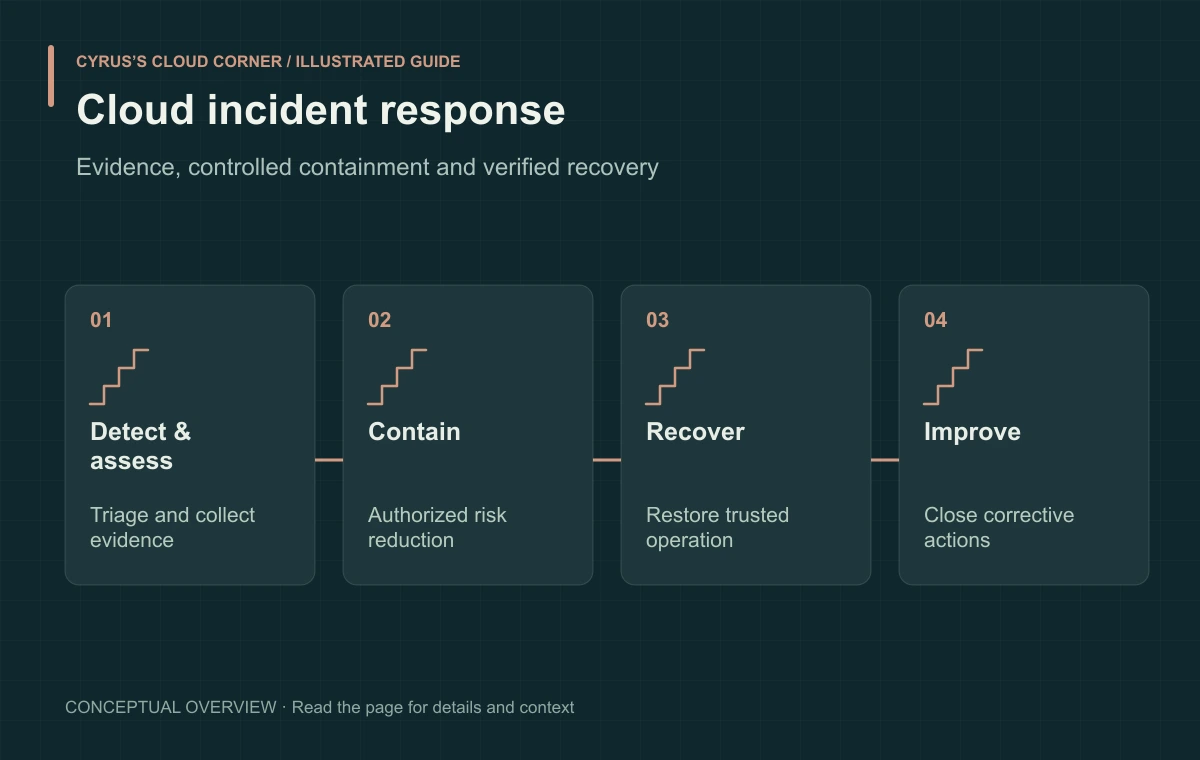
Turn incident lessons into an executable response plan: detect, investigate, contain, recover, and improve—with evidence and authority defined before the incident.
Published and sources reviewed: October 26, 2026 · Practical architecture guide
Prepare the response system
NIST SP 800-61 Revision 3 connects incident response with broader cybersecurity risk management. For a cloud team, readiness includes reliable logs, known owners, access to provider support, escalation paths, evidence handling, and recovery capability.
Define who can revoke an identity, isolate a workload, preserve evidence, restore data, and communicate externally. A technically possible action is not automatically an authorized response. Consider business impact and legal or contractual escalation through qualified owners.
Playbook: suspected stolen credentials
Illustrative scenario: a workload identity makes an unexpected export request. Preserve relevant identity and access records, establish the incident timeline, and determine the scope of the identity’s permissions and sessions. Correlate the alert with actual activity instead of assuming that every anomaly is malicious.
Use the approved containment path to restrict exposure and revoke affected credentials or sessions. Confirm the provider-specific behavior: disabling a key may not invalidate every derived session. Investigate persistence, newly created identities, changed policies, and accessed data before declaring containment complete.
Playbook: exposed storage
Establish which resource and data were exposed, how access was granted, and whether access records are available. Apply approved restrictions while preserving evidence of the original configuration. Review linked identities, copies, exports, and downstream consumers.
Do not equate “the bucket is private now” with “no information was accessed.” Record what the evidence supports, what remains unknown, and the decisions made by the incident owner.
Recovery needs verification
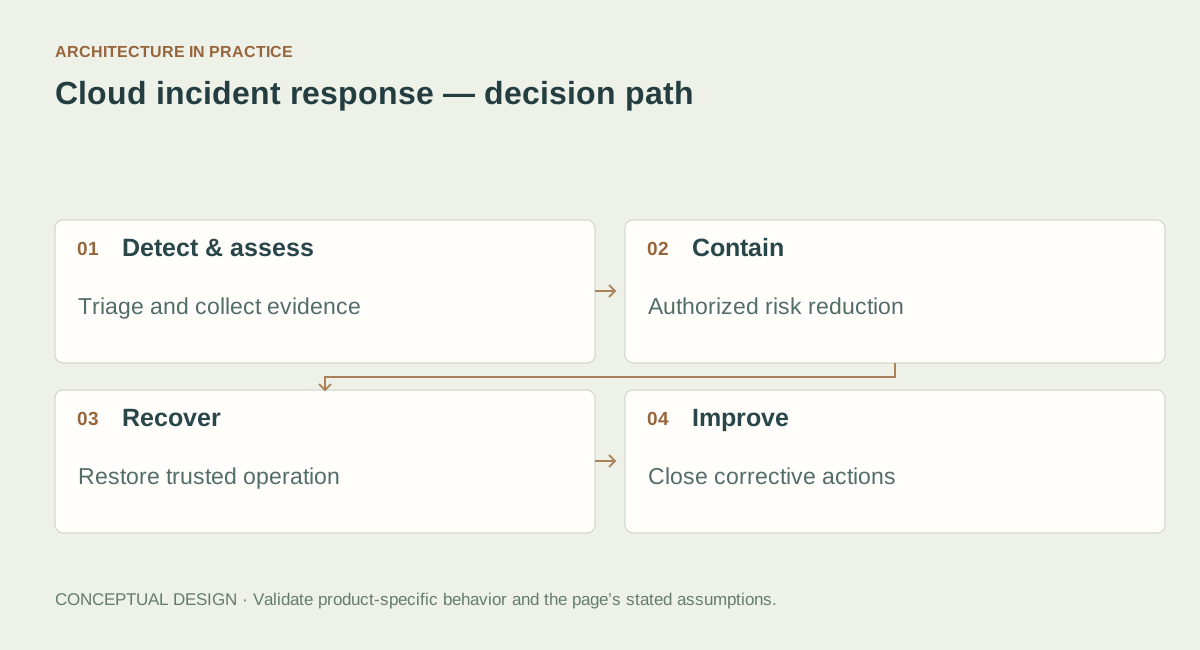
- Restore from a trusted recovery point and test application integrity.
- Correct the entry path and any persistence before reconnecting systems.
- Validate keys, identities, configuration, and critical data.
- Monitor restored services and document remaining uncertainty.
Exercise response through a tabletop and a controlled recovery test. Track time to evidence, containment confidence, and restoration results. Convert lessons into owned changes with completion evidence.
Implementation checklist
- Assign incident roles and escalation contacts.
- Verify access to audit evidence.
- Record approved containment authority.
- Test credential and session revocation.
- Protect recovery copies and dependencies.
- Verify restoration and application integrity.
- Track lessons to completed corrective actions.