Understand the building blocks behind modern AI: models, tokens, context, embeddings, training, and inference. Start with the concepts, then connect them to a practical cloud application.
Content reviewed: October 25, 2026 · Practical guide
Start with the task, not the model
Artificial intelligence is a broad field. A classifier assigns a category, a forecasting model estimates a future value, and a generative model creates an output such as text or an image. The right design depends on the decision or task you need to support—not on whether a model is the newest or largest.
For a document assistant, the useful requirement is not “use AI.” It is “help an authorized employee find the current policy, explain the relevant passage, and show its source.” That statement gives the team something concrete to build and evaluate.
A vocabulary for reading AI architecture
| Concept | What it means in an application |
|---|---|
| Model | A learned mapping that produces outputs from inputs. Its training does not guarantee factual or appropriate answers. |
| Token | A unit produced by a tokenizer. A token can be part of a word, punctuation, or another representation; it is not reliably one word. |
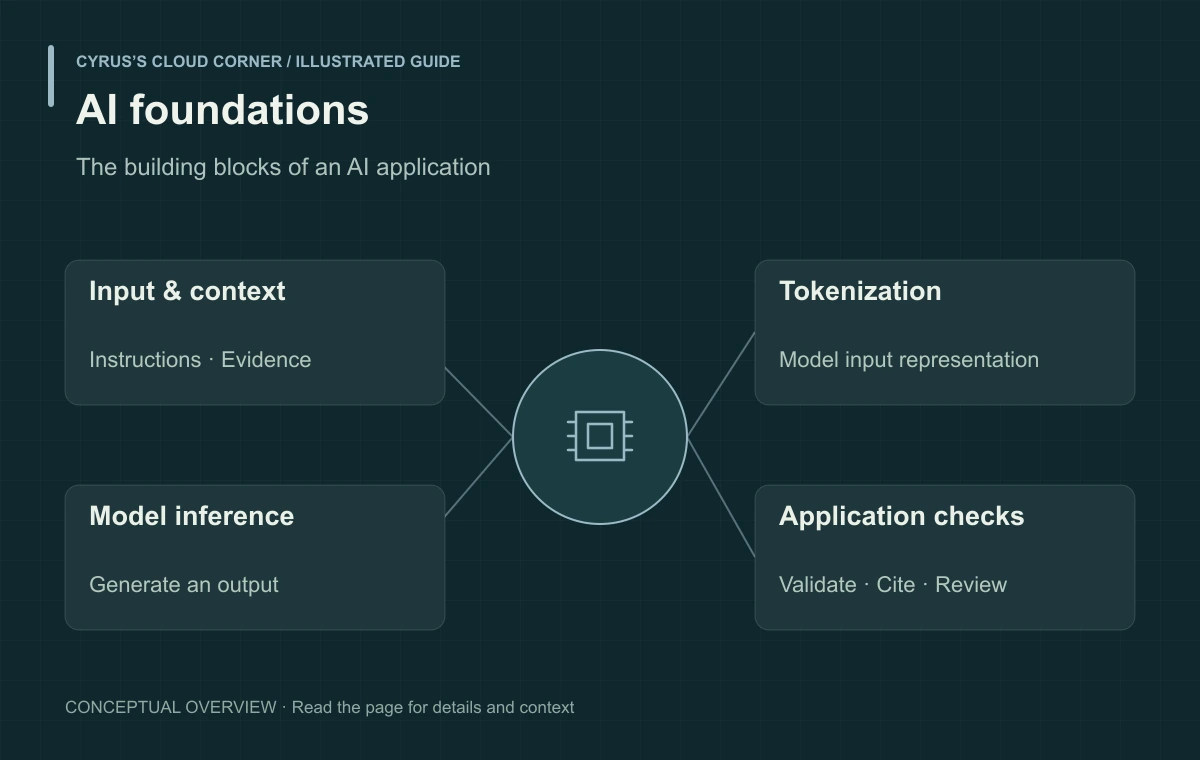
| Context | The information available for a particular request, including instructions, conversation, retrieved passages, and tool results. |
| Embedding | A numerical representation used to compare items in a learned representation space. Similarity is useful evidence, not proof that two items mean exactly the same thing. |
| Inference | Using a model to produce an output. This is different from updating model parameters through training. |
Training, prompting, retrieval, and fine-tuning
Training changes model parameters. Prompting supplies instructions and context for a request. Retrieval supplies selected external information at runtime. Fine-tuning adapts an existing model using additional training examples. These techniques solve different problems and can be combined.
A practical starting point is a clear prompt and a small evaluation set. Add retrieval when answers need changing or private reference material. Consider fine-tuning when you have a measured behavioral gap, suitable examples, and a reason that simpler changes cannot meet the requirement.

Worked example: a policy question
Illustrative design: an employee asks which travel policy applies to a trip. The application authenticates the employee, retrieves permitted policy passages, supplies them as context, and asks the model for a short explanation with citations. The application then presents both the answer and the supporting passages.
A fluent answer is not enough. Check that the cited policy is current, the retrieved passage actually supports the answer, and the employee is allowed to see it. If the evidence is missing or contradictory, the assistant should explain the limitation instead of inventing a rule.
Security and operating boundaries
- Keep credentials out of prompts and retrieved documents.
- Treat retrieved text as evidence, not as permission to change system behavior.
- Do not use the model as the access-control engine.
- Measure quality on realistic examples before expanding the scope.
- Track input size, latency, output quality, and failures together.
Sources & further reading
Primary references reviewed for this guide. Worked examples and delivery checklists are illustrative design guidance.