Evaluate whether an AI application performs its intended task safely and reliably, then monitor it as models, prompts, data, and users change.
Content reviewed: October 25, 2026 · Practical guide
Define success before choosing a score
Begin with observable outcomes: a supported answer, a correctly routed request, a valid extraction, or an appropriate refusal. Evaluate the full application when that is what users experience. A strong model benchmark result does not establish that your retrieval, permissions, tools, and interface work correctly together.
Build a small but deliberate test set covering ordinary requests, edge cases, ambiguous questions, denied access, missing evidence, and adversarial input. Keep a separate held-out set so repeated tuning does not merely memorize the development examples.
A balanced evaluation scorecard
| Dimension | What to examine |
|---|---|
| Task quality | Correctness, completeness, usefulness, and evidence support. |
| Safety and access | Inappropriate disclosure, unauthorized actions, and failure to refuse. |
| Reliability | Tool failures, timeouts, retries, and recovery behavior. |
| Performance | End-to-end latency and the spread of slow requests. |
| Cost | Work consumed per successful task, not just per model call. |
Use automated and human review carefully
Deterministic tests are useful for schemas, required fields, allowed destinations, and exact business rules. Human reviewers can judge usefulness and nuanced errors. Model-based graders can help scale rubric-driven review, but their judgments also need calibration and spot checks.
For retrieval systems, separate evidence retrieval from answer quality. For agents, inspect the sequence of actions as well as the final response. A correct-looking answer can conceal an unauthorized or wasteful execution path.

Worked example: a release comparison
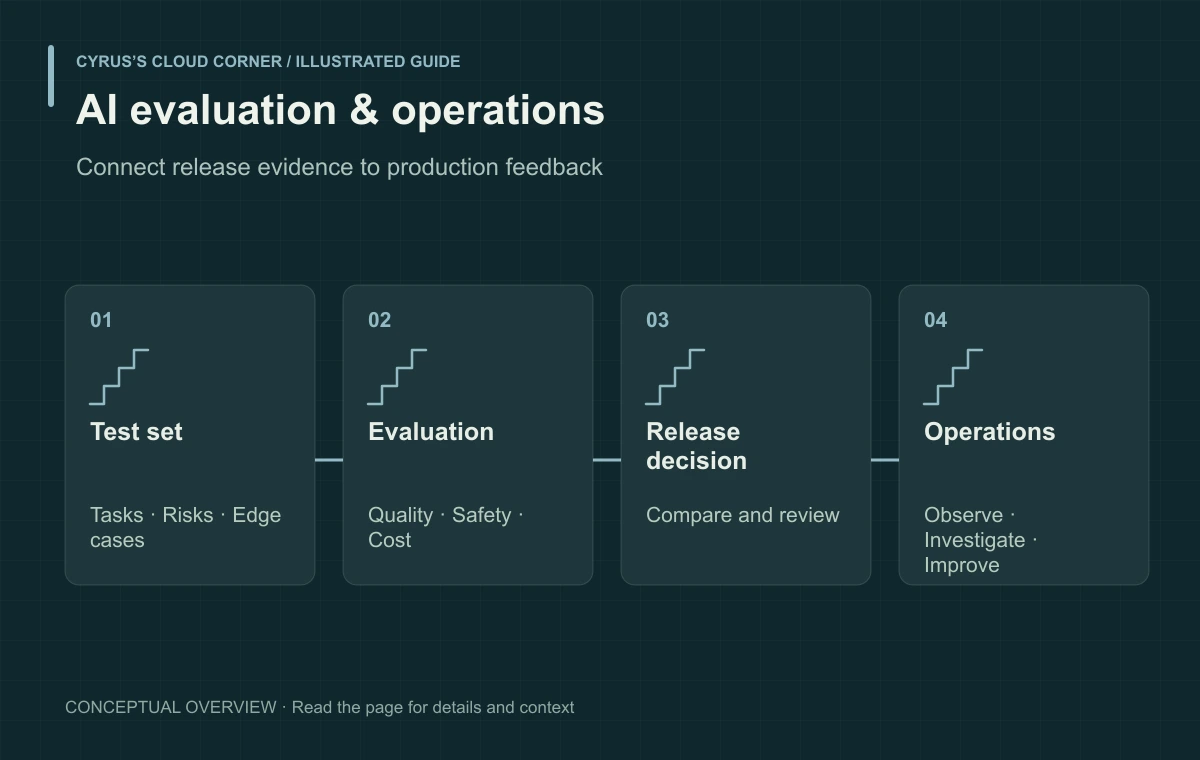
Illustrative design: compare the current document assistant with a candidate prompt or model on the same frozen questions and source versions. Review unsupported claims, citation accuracy, denied-access behavior, latency, and cost. Inspect regressions rather than allowing one aggregate score to hide a serious failure category.
Agree on release gates before viewing the candidate results. Use staged exposure when appropriate, retain a rollback path, and record the versions of the model, prompts, tools, and retrieval settings that produced the evidence.
Observe without collecting everything
A trace can connect the user request, retrieval steps, model calls, tool decisions, and errors. Log identifiers and operational signals needed for investigation, but avoid treating unrestricted prompt storage as a default. Apply redaction, access controls, retention limits, and an explicit purpose to sensitive telemetry.
Monitor the quality of outcomes over time. Changes in source content or user questions can reduce usefulness even when the service remains available and its infrastructure metrics look healthy.
Sources & further reading
Primary references reviewed for this guide. Worked examples and delivery checklists are illustrative design guidance.