Three illustrative application designs show how AI architecture, security, evaluation, and governance fit together. They are worked examples, not claims of deployed customer projects or measured business results.
Content reviewed: October 25, 2026 · Practical guide
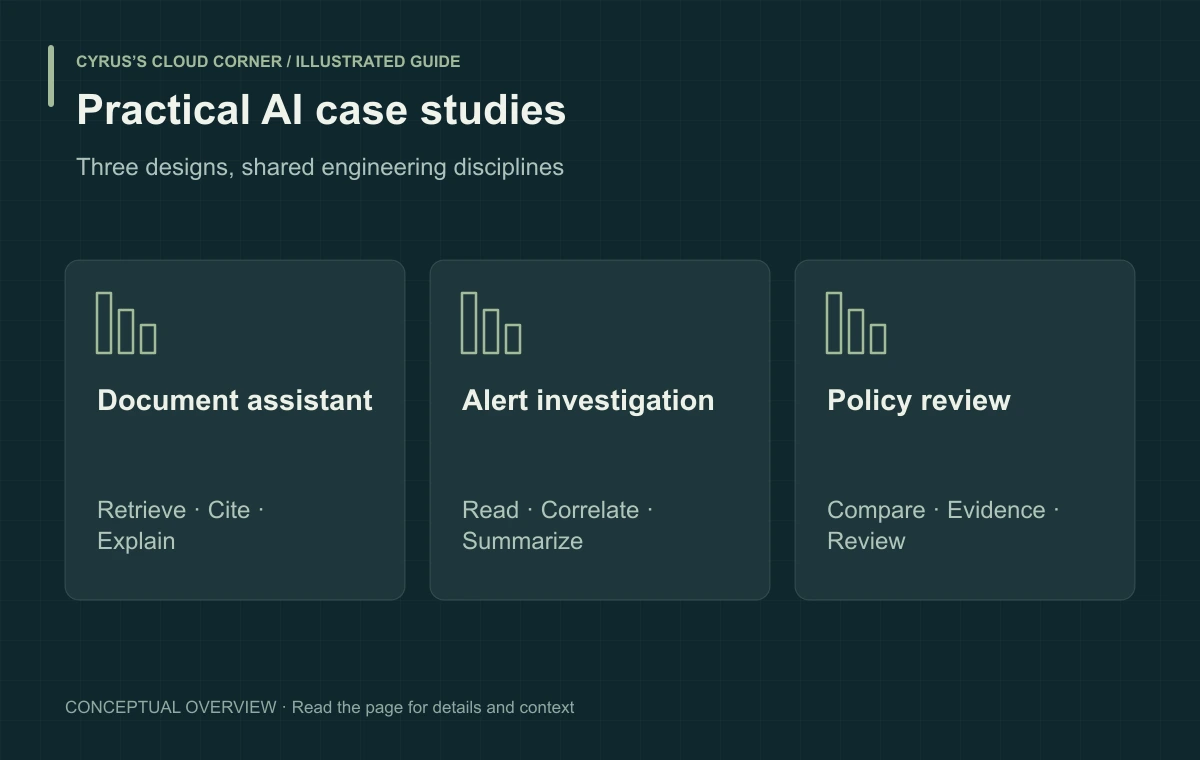
Case 1: an internal document assistant
Objective: help employees locate and explain an approved policy with supporting sources. The application authenticates the user, retrieves permitted passages, generates an evidence-based response, and displays citations. Document owners control source quality and updates.
Security boundary: restricted documents must be excluded before they enter context. Evaluation should cover answer support, stale sources, conflicting policies, revoked access, and questions the corpus cannot answer. A useful failure response states what evidence is missing and points to a human owner.
Design lesson: improving retrieval and source maintenance can matter more than switching to a larger model.
Case 2: a security-alert investigation assistant
Objective: turn an alert and approved evidence into an investigation summary. Read-only tools retrieve logs and relevant runbooks. The assistant separates observations from hypotheses and identifies the next evidence needed to confirm or reject a hypothesis.
Security boundary: investigation does not imply permission to remediate. Any account disablement, network change, or external communication belongs behind a separately authorized action path. Test empty logs, misleading records, failed tools, injected instructions, and incorrect entity matching.
Design lesson: successful summarization and safe action execution are different capabilities and should have different release gates.
Case 3: a policy and control review assistant
Objective: highlight potential gaps between a draft policy and selected control references. The application presents candidate observations, their supporting passages, and an explanation of uncertainty. A qualified policy owner decides whether an observation is valid and what action to take.
Security boundary: a generated observation is not a compliance opinion, certification, or accepted risk decision. Keep drafts confidential, control the reference set, and preserve review outcomes with an appropriate retention policy.
Design lesson: human oversight works best when the reviewer can inspect evidence and reject the output, rather than merely approve a polished summary.

A reusable review template
| Area | Record before implementation |
|---|---|
| Task | Who needs what outcome, and what is outside scope? |
| Architecture | Which data sources, models, tools, and identities participate? |
| Risk | What would a misleading answer or unauthorized action affect? |
| Evidence | Which examples, metrics, and human reviews support release? |
| Operations | Who monitors, investigates, changes, and retires the application? |
Move from example to pilot
Choose one narrow use case and make a baseline without autonomous write actions. Prepare approved test data, define access boundaries, agree on release criteria, and assign an owner. Expand only after the evidence shows where the system helps and where it still fails.
A good pilot produces more than a demo: it produces a documented task, a test set, a threat model, an operating plan, and a defensible decision about what to do next.
Sources & further reading
Primary references reviewed for this guide. Worked examples and delivery checklists are illustrative design guidance.