Build an actionable record of cryptographic dependencies, with owners, evidence, and migration decisions.
Content reviewed: October 25, 2026
Discover beyond internet endpoints
Combine application-owner interviews, certificate inventories, configuration review, dependency analysis, and permitted network observations. A TLS scan alone misses code signing, embedded devices, offline workflows, backups, private services, and cryptography inside libraries.
Use authorized discovery methods. Passive observation can miss infrequent paths; static analysis can find unused code. Record confidence and reconcile conflicting evidence before deciding that a dependency is absent.
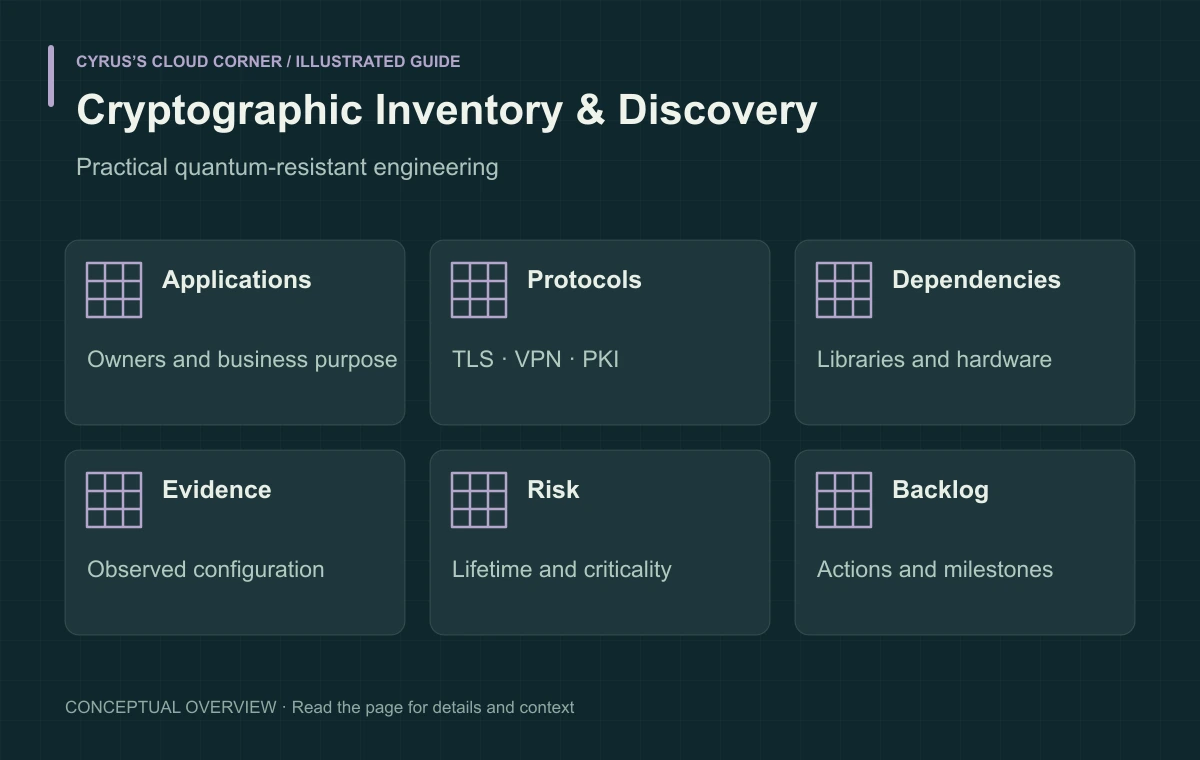
A minimum useful inventory
| Record | Why it matters |
|---|---|
| Service, owner, environment | Find the team that can make and validate a change. |
| Cryptographic purpose | Separate transport, signing, authentication, and stored-data protection. |
| Algorithm, library, version, protocol | Locate a supported upgrade path. |
| Data lifetime and criticality | Prioritize exposure and business impact. |
| Supplier, hardware, dependencies | Expose procurement and lifecycle constraints. |
| Evidence, date, confidence | Show what was observed and what still needs verification. |

Turn discovery into a backlog
Group dependencies by shared library, gateway, certificate authority, or appliance rather than creating isolated tickets for every endpoint. One platform change may affect many services; one legacy client may prevent an otherwise simple rollout.
Keep the record alive
- Assign an owner and next action to every high-priority dependency.
- Capture cryptographic changes in deployment and procurement reviews.
- Retest after library, certificate, proxy, or firmware updates.
- Track unknown coverage and unsupported products as explicit risks.