Compare cloud AI options using the same workload and requirements. Start with identity, data, evaluation, and operating constraints rather than a list of model names.
Content reviewed: October 25, 2026 · Practical guide
Use one reference workload
Consider a read-only internal document assistant. It needs an authenticated user, authorized retrieval, model inference, source citations, monitoring, and a way to handle insufficient evidence. Keep that workload constant when comparing platforms; otherwise, differences in the prototypes can be mistaken for differences between providers.
Separate the application contract from provider-specific implementation. A consistent interface for inference, retrieval, tool authorization, and evaluation makes decisions easier to explain and future changes easier to test.
Map services to capabilities
| Provider | Examples of platform families to investigate | Design question |
|---|---|---|
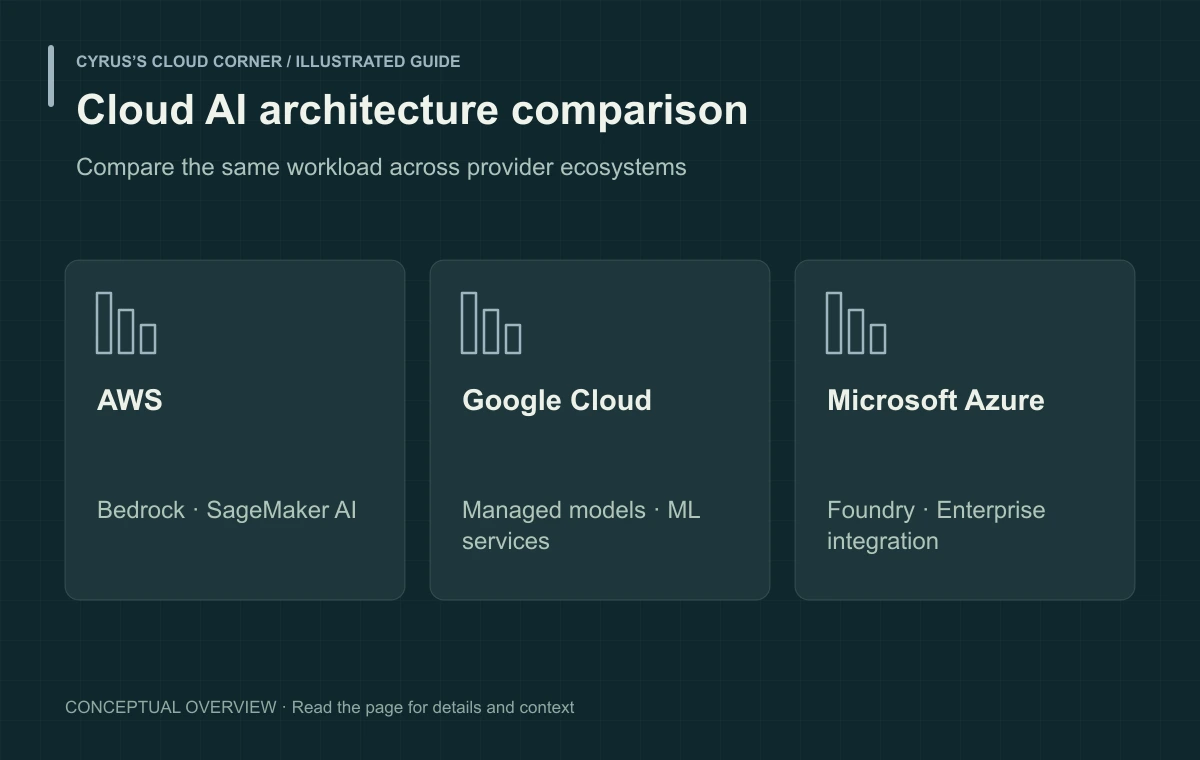
| AWS | Amazon Bedrock for foundation-model applications; SageMaker AI for ML development, training, and deployment. | Which parts should be managed, and where is custom ML control required? |
| Google Cloud | Managed models, agents, and ML capabilities in Google Cloud’s AI platform documentation. | How should model access connect to existing data and operating workflows? |
| Microsoft Azure | Microsoft Foundry for models, agents, tools, and enterprise operations. | How should identity, networking, governance, and application integration be configured? |
Product names and service packaging evolve. These are starting points for investigation, not a guarantee that equivalent capabilities, model versions, regions, or contract terms exist in every offering.
Compare the dimensions that affect the workload
- Identity: caller identity, service identity, permissions, and tool boundaries.
- Data: document location, access filtering, retention, and permitted processing.
- Models: task performance on your evaluation set and required modalities.
- Operations: tracing, monitoring, incident response, and rollback.
- Economics: end-to-end cost, including retrieval, storage, operations, and engineering.
- Portability: interfaces, data formats, evaluation assets, and replacement effort.

Worked example: a fair proof of concept
Illustrative design: use the same approved document set, permission scenarios, questions, scoring rubric, and latency measurement across candidate platforms. Record configuration choices and service regions. Test data deletion and revoked access as deliberately as successful answers.
The result should be a decision record explaining tradeoffs for this workload. Avoid presenting a single “winner” as the best cloud for every team, dataset, and compliance context.
Architecture before procurement
Draw the data flow and trust boundaries before accepting a design. Identify which party controls each layer and what evidence will demonstrate the required behavior. Confirm regional availability, current pricing, and service-specific commitments directly before implementation.
For a team already operating securely on one cloud, familiarity and existing controls may be valuable. That is a hypothesis to test against requirements, not a reason to skip evaluation.
Sources & further reading
Primary references reviewed for this guide. Worked examples and delivery checklists are illustrative design guidance.