Understand the difference between key establishment, encryption, and signatures before choosing a migration approach.
Content reviewed: October 25, 2026
Three jobs, different dependencies
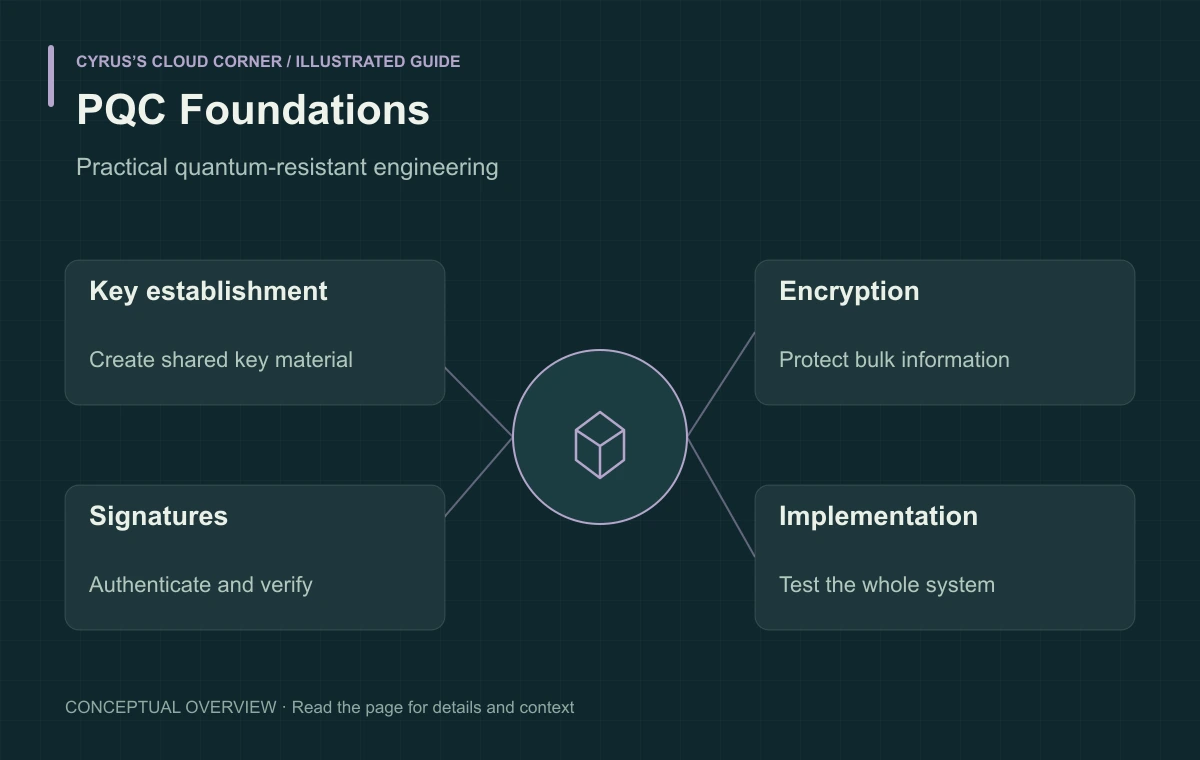
Public-key key establishment lets parties agree or establish shared key material. Symmetric encryption protects the bulk data. A digital signature lets a verifier check authenticity and integrity under a particular trust model. A change to one job does not automatically modernize the other two.
For example, hybrid key establishment on a TLS connection can improve protection against future decryption while its certificate chain still uses a traditional signature algorithm. Document both layers.
Quantum resistance is an engineering claim
PQC algorithms are designed to resist known classical and quantum attacks. That does not eliminate implementation flaws, side channels, weak random generation, key theft, or mistakes in the surrounding protocol. A secure algorithm inside a poorly controlled application is not sufficient.

Read a vendor claim critically
- Ask which algorithm, parameter set, and protocol are supported.
- Distinguish a prototype from a supported production feature.
- Request interoperability evidence for the client, server, proxy, and hardware combination.
- Check key storage, certificate handling, monitoring, and recovery.
- Keep algorithm support separate from module-validation and compliance claims.
A useful first exercise
Draw one application’s cryptographic path from client to endpoint and through each internal hop. Mark key establishment, certificate authentication, data encryption, signing, and key storage. Identify the owner of each dependency and the evidence needed to confirm its configuration.