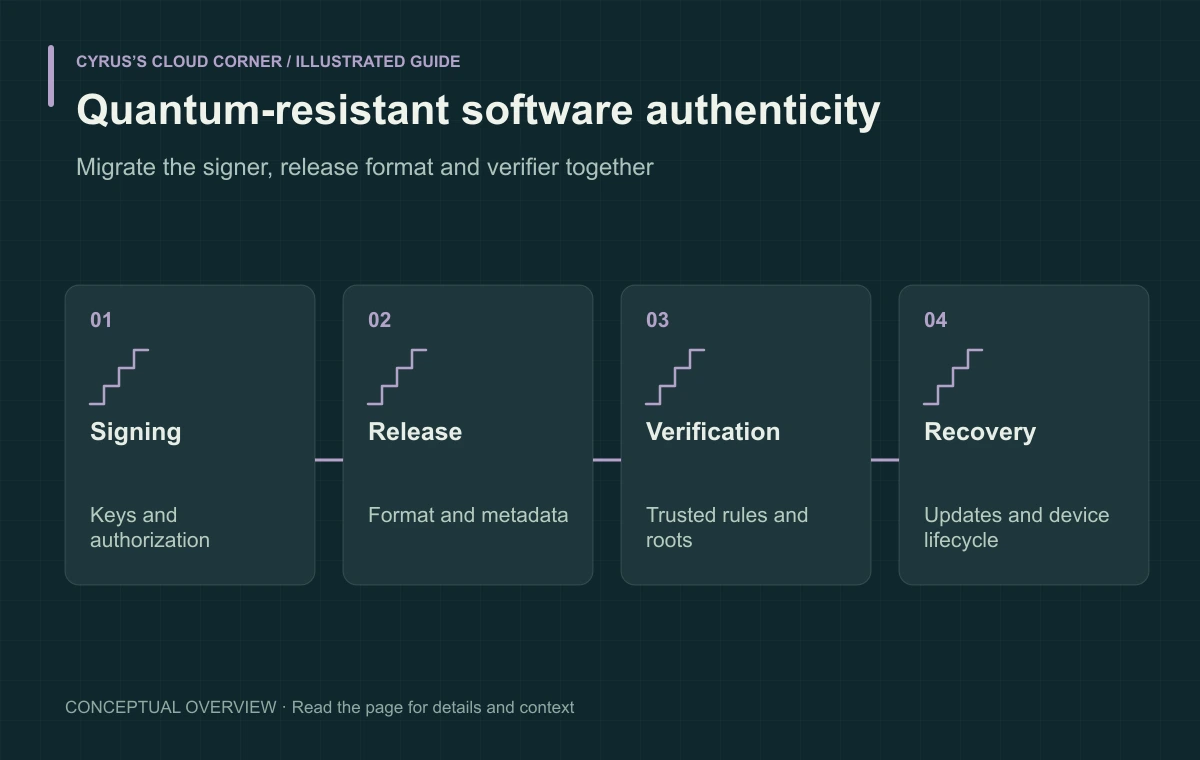
Plan for long-lived software authenticity as well as transport confidentiality. Signing keys, trust anchors, update formats, and verification code all belong in the migration scope.
Published and sources reviewed: October 26, 2026 · Practical architecture guide
Different from transport protection
A quantum-resistant TLS key exchange does not change how a device verifies a software release. Code-signing migration concerns the signature format, trusted issuer or key, verification implementation, and update process. A product may use different cryptography at each layer.
NIST FIPS 204 and 205 specify post-quantum signature algorithms. Their publication does not mean that every firmware format, certificate profile, HSM, operating system, or boot chain supports them. Confirm the complete product path.
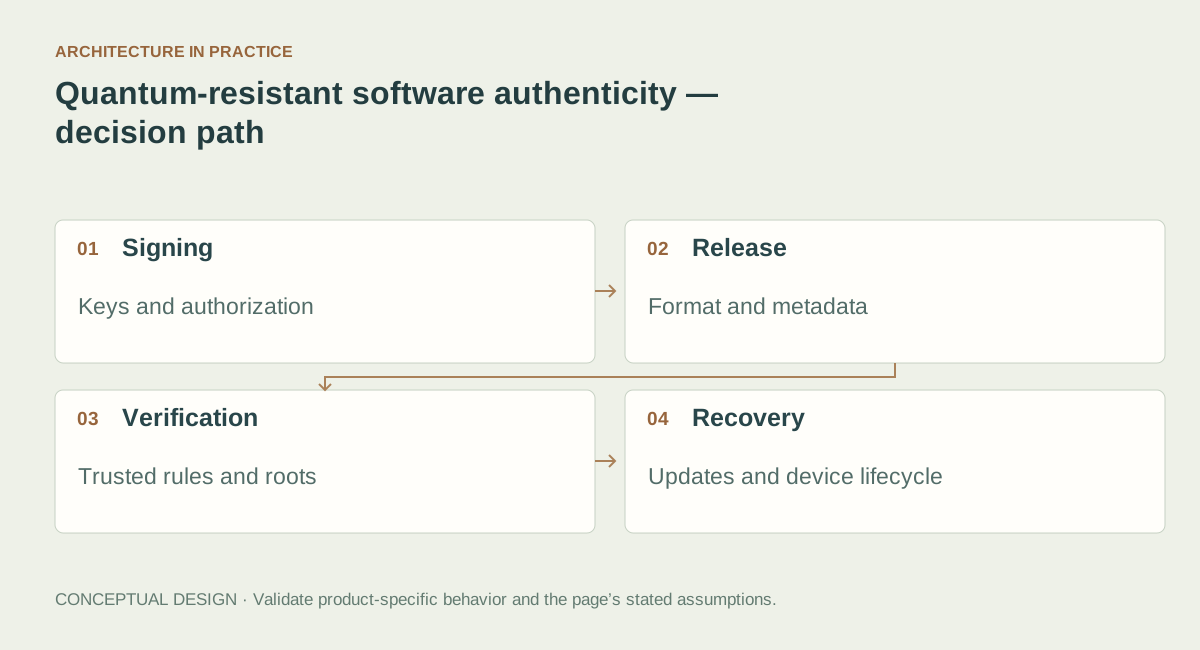
Inventory the trust chain
| Dependency | Migration question |
|---|---|
| Signing service | Which algorithms, key storage, and approval controls are supported? |
| Release format | Can it carry the required signature and metadata? |
| Verifier | Can installed software validate the new format safely? |
| Trust anchor | How can a trusted key or root be updated? |
| Device lifecycle | Which devices cannot receive a compatible verifier update? |
Prioritize systems with long service lives and limited update capability. An immutable or difficult-to-replace trust anchor can determine the migration lead time more than the signing service does.
Worked example: staged verifier upgrade
Illustrative design: an organization first delivers a supported verifier and trust-store update through its existing trusted process. Only after verifying deployment coverage does it introduce releases using the new approved signature profile.
Where a product supports multiple signatures, test its exact acceptance rules. Requiring both signatures is different from accepting either one. A permissive fallback can defeat the intended protection. Avoid inventing an unreviewed hybrid signing format.
Protect update and recovery behavior
Test signature failure, revoked or unknown keys, rollback to older releases, partial updates, power loss, and recovery media. Keep release authorization separate from the possession of a signing key. Document what happens to devices that cannot migrate.
NIST firmware-resiliency guidance emphasizes protection, detection, and recovery. Use those operating goals alongside current cryptographic profiles; this page is a planning guide, not an assertion that a particular vendor supports a deployable PQC boot chain.
Implementation checklist
- Inventory signing, verification, and trust-anchor dependencies.
- Assess device life and update capability.
- Check supported algorithms and release formats.
- Define verifier upgrade and trust-store sequencing.
- Test multiple-signature acceptance rules.
- Exercise rollback protection and recovery.
- Document unsupported devices and residual risk.