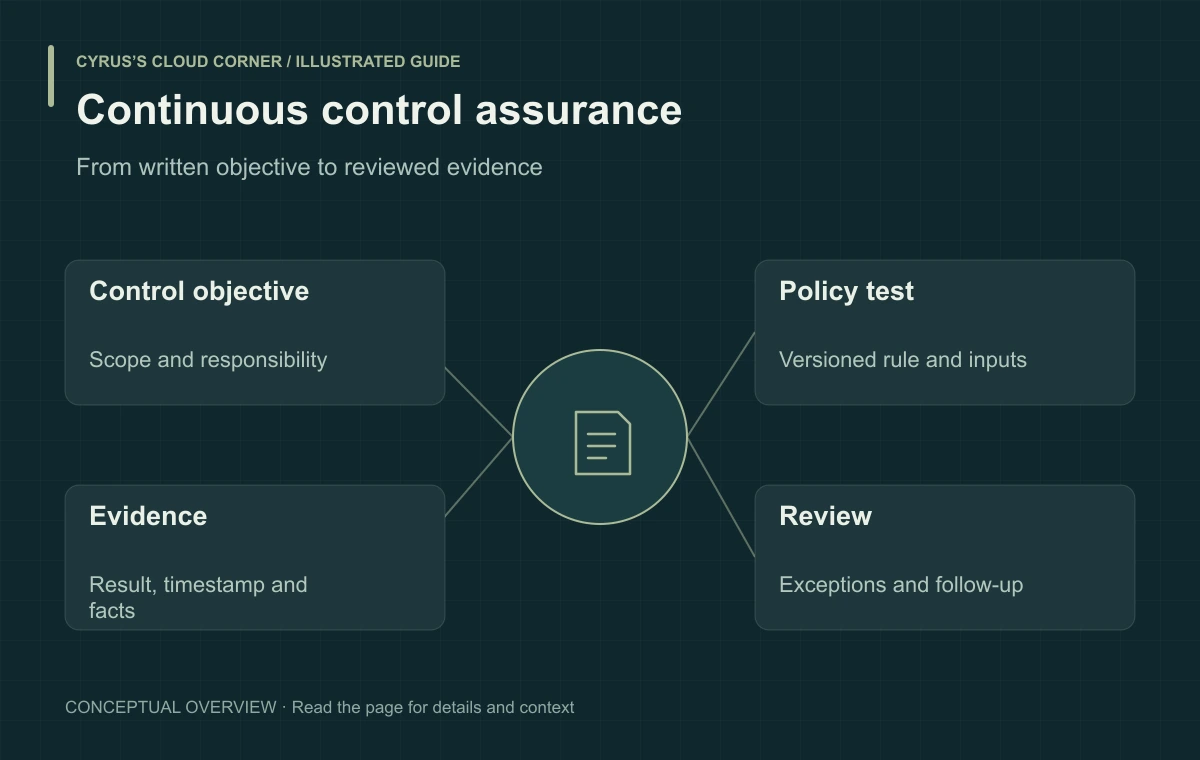
Connect a control objective to testable implementation, trustworthy evidence, accountable review, and a defined exception process.
Published and sources reviewed: October 26, 2026 · Practical architecture guide
Begin with the control objective
A policy engine evaluates a rule against inputs. It does not decide which legal or contractual requirements apply, whether every relevant system was assessed, or whether the evidence is sufficient for an audit opinion. Those decisions need accountable owners.
Write the objective in plain language before choosing a tool. Define scope, responsibility, evidence, testing frequency, and failure handling. Separate preventive enforcement from detective checks and from human review.
Worked example: restricted public storage
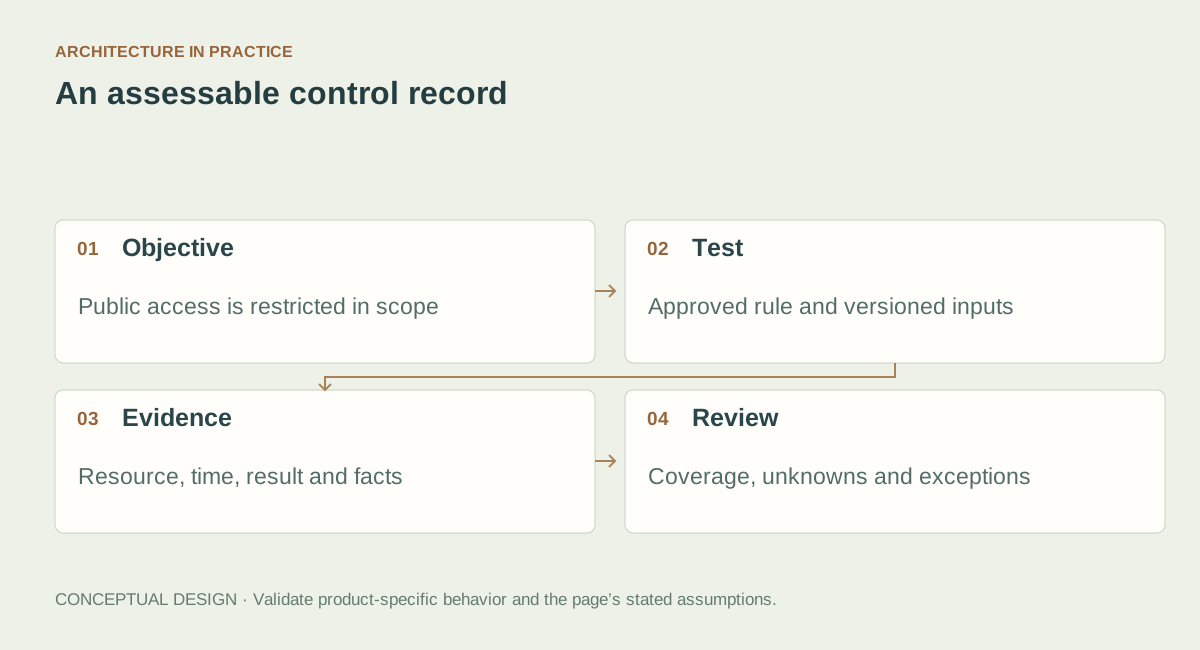
Illustrative objective: production storage must not allow anonymous public access unless an approved exception applies. A deployment check inspects proposed configuration, and a runtime check assesses deployed resources. Both produce evidence tied to a resource identifier, rule version, and observation time.
The reviewer checks coverage and exceptions, rather than interpreting a green dashboard as proof that every resource was evaluated. A failed collector, unsupported resource type, or stale snapshot should produce an unknown or failed-assessment state—not silent compliance.
A useful evidence record
| Field | Purpose |
|---|---|
| Resource and scope | Identify exactly what was assessed. |
| Control and rule version | Connect the result to an approved objective. |
| Observation and collection time | Distinguish current state from historical evidence. |
| Result and supporting facts | Explain the decision and preserve relevant inputs. |
| Owner and exception | Assign follow-up and document permitted departures. |
Test the policy as software
Use positive, negative, boundary, missing-input, and exception tests. Review rule changes through version control. Open Policy Agent documents policy testing, but the same engineering discipline applies when using provider-native policy tooling.
Protect evidence integrity and access. Define retention and minimize sensitive data in collected records. Track assessment coverage, stale evidence, unresolved failures, and expiring exceptions together. Automation should make the assurance process inspectable, not simply faster.
Implementation checklist
- Define objective, scope, and accountable owner.
- Distinguish prevention, detection, and review.
- Test allowed and prohibited configurations.
- Represent unknown and stale evidence explicitly.
- Version the policy and evidence schema.
- Protect evidence access and retention.
- Review exceptions and coverage gaps.