Measure cost against useful outcomes. Architecture choices, ownership, quality, reliability, and financial accountability belong in the same conversation.
Published and sources reviewed: October 26, 2026 · Practical architecture guide
Define the unit of value
Cost per request is useful, but it can hide failed requests, repeated attempts, and poor-quality answers. For an AI assistant, also consider cost per successfully resolved task at an agreed quality threshold. State which costs and outcomes are included.
FinOps connects engineering, finance, and business decisions. For AI workloads, spending can include model inference, training, retrieval, storage, observability, networking, and supporting infrastructure. Allocation and forecasting should reflect that complete path.
Make assumptions explicit
| Cost driver | Architecture question |
|---|---|
| Model inference | What input, output, retry, and tool-call volume is expected? |
| Retrieval | How often are documents indexed and searched? |
| Idle infrastructure | Which endpoints or accelerators remain provisioned? |
| Data movement | Where do traffic, exports, and cross-region dependencies occur? |
| Operations | What testing, monitoring, and human review does the workflow require? |
Use current regional price sheets for actual estimates. This guide deliberately avoids fixed vendor prices that would become stale.
Worked example: a document assistant
Illustrative scenario: compare two model configurations on the same approved evaluation set. Measure supported answers, latency, input and output size, retries, retrieval costs, and human escalation. The lower-priced model may be better, worse, or equivalent once the complete task is measured.
Consider shorter context, better retrieval, bounded output, and caching only where permissions, freshness, and correctness remain valid. A shared cache must not disclose another user’s answer or serve content after access is revoked.
Budgets are signals, not complete controls
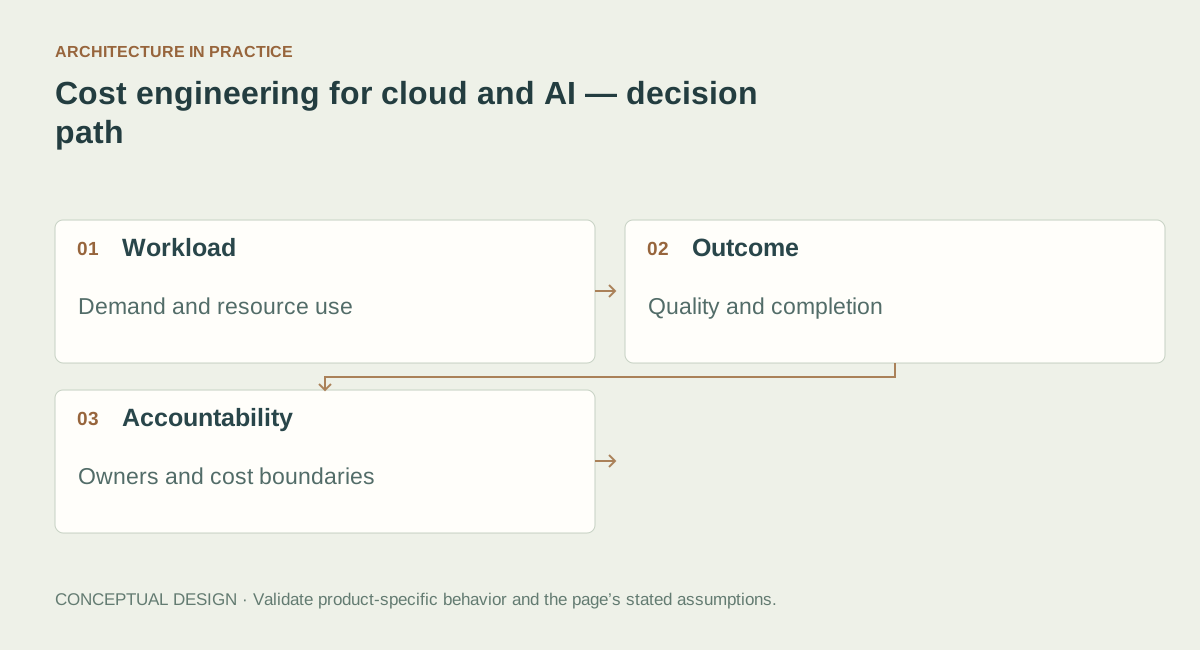
Budget alerts help owners respond, but should not be assumed to stop spending. Check the actual enforcement mechanisms, quotas, rate limits, and shutdown behavior of the selected service. Protect production availability when defining automated actions.
Report forecast variance, unallocated spend, idle capacity, quality-adjusted task cost, and the effect of changes. Avoid trading away necessary audit evidence, backup capability, or security controls for a lower bill.
Implementation checklist
- Define a measurable useful outcome.
- Include supporting infrastructure and operations.
- Allocate costs to an accountable owner.
- Evaluate cost and quality on the same test set.
- Bound retries, output, and tool loops.
- Validate cache permissions and freshness.
- Test actual spend-control behavior.